

My last article was about how we are supposed to make sense of the tidal wave of claims and projections around AI in the last few months. Today, I want to write a little more about the hype-to-reality gap and then share some of my own experience with what AI can actually do and how that conflicts with the more hyperbolic projections.
The biggest claims are coming from AI companies themselves. Anthropic (the company that built Claude) has been making a lot of attention-getting headlines recently. One is that they had 16 Claude agents build a C compiler capable of building Linux 6.9 and this task cost $20,000 of compute.
This is a fun marketing trick. A compiler is a pretty complex piece of software but there are also a lot of them out there. Building a compiler is an undergraduate computer science project which means that 1) there are a lot of examples to draw from 2) it is an extremely well documented task. But it’s very unlikely that your business needs a new C compiler. This is an AI triumph designed not to bring a new and good thing into the world but simply to sound impressive.
The more interesting business story is from this Anthropic engineer who claims he gave Claude a technical specification and then let it do development autonomously, resulting in a production-ready product.
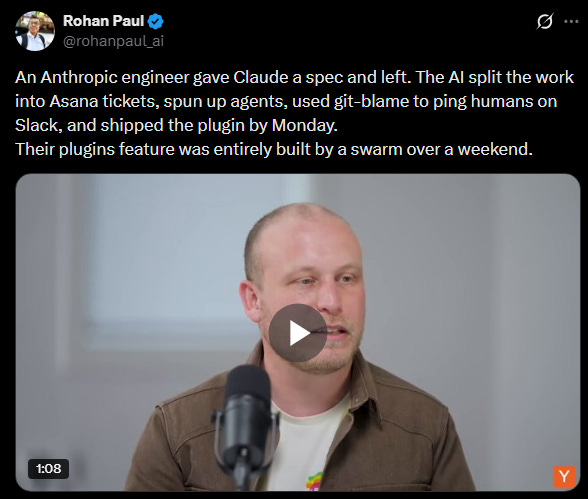
This is more in line with the kind of work that most software engineers do and, if this is something that an AI coding agent can reliably accomplish, it has really big implications for the future of software work.
When I worked for Very Large Tech Company, I did a lot conference talks and tech demos aimed at our existing community of developers. The goal was always “let me show you something new and exciting and then let me show you how to build it for yourself.” That last part was always crucial. No demo is valuable if our developers can’t predictably and reliably replicate it for themselves.
I look at the promotional promises that AI is making and I’m also watching my friends and collogues work in this space and there seems to be a significant gap between the promise and the practice. This experience is closer to what I’ve seen from developers earnestly engaging this technology
Ok, I think my experiment leaving AI working on stuff 24/7 ends here. It doesn’t work. Code explodes in complexity, results are not that great, the AI can’t get past hard walls… and is insanely expensive (spent ~1k over the last 2 days).
I think the dream of having AI’s working on the background and making real progress on things that matter (i.e., truly new things) isn’t here yet. It is still a machine hard-stuck on its own training data, incapable of thinking out of the box. It is great for building things that were already built. But not new things
Also coding normally has the under-appreciated advantage that you’re doing two things at the same time: building a codebase *and* learning it. AI’s do only half of that. The other half is obviously impossible.
I actually disagree on the “obviously impossible” part, but I think the way in which AI might learn from a codebase that it is building is different from the way a human learns from building a codebase.
When I start talking about how the promise of autonomous AI development doesn’t seem to be matching the rhetoric, I see one of two reactions. The first is “just wait, it’s coming”. This is kind of true. AI capabilities in the field of software have improved dramatically over the last year. But the category of problems that it has now are pretty similar to the problems it had a year ago.
The other reaction is “oh, well you’re just not doing it right”. I deeply dislike this response because it’s what I call the “weight loss supplement pitch”. It’s a strategy where I promise you a miracle solution but, when that solution doesn’t work for you, I blame you for not doing a hundred other things you need to do to get the miracle. It’s a sales tactic I really despise because it screws with the “expectation-to-implementation” process. If you tell me “in my demo, AI did XYZ”, I want to use the AI to do XYZ. If I can’t get it to do that, I’m going to look at your original statement as more of a sales tactic. Developers don’t like sales tactics. My experience with practical developers is that they are ok if you tell them that a process is complicated and has 23 detailed steps before you see productivity gains out of it. They’re fine with that story as long as you give it to them straight.
The View From The Trenches
From inside the world of software, the view is not what Anthropic is promoting in terms of fully autonomous feature creation. But AI agents as a core development tool are a very real thing. They are really writing functional code and speeding the development process.
