

The world of punditry is a dismal place and there is nothing more dismal than the omnipresent pronouncements that the results of a given trend of policy will set the stage for a future of doom and despair.
When you know how to look for it, this behavior is everywhere. It was more prevalent during Covid because everyone was so certain that they had science on their side. People made endless prediction about the path of the pandemic based on assumptions or models or “common sense” but weeks would pass and reality would stubbornly refuse to fit into the tidy narratives.
I was reminded of this today when New York Times reporter Ben Mullin wrote about how, despite the fact that Congress slashed a half billion in funding for public media, few of the stations have shut down. This is in contradiction to the predictions of “experts”.
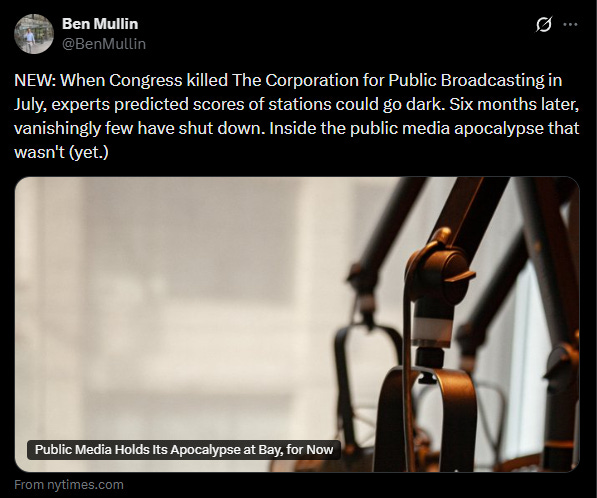
First of all, I say “bravo” to Mullin for daring to write a piece that exposes the errors of this particular narrative. I’m used to people simply ignoring the errors of the past and pretending like they were simply correct all along. Rarely do people return to their inaccurate predictions and say “huh. Guess I missed on that one.” It is even rarer for people to wonder why they got it wrong and re-evaluate their position so that they can be less wrong in the future.
I will temper that praise by noting that Mullin does not name and shame the “experts” who got this prediction so wrong. He notes that “according to one estimate, 78 public radio stations and 37 TV stations were at risk of going dark” but doesn’t inform readers that this estimate was made by the Public Media Company based on data from the Corporation for Public Broadcasting. Nor does he point readers to the fact that he uncritically reported this data months ago, going so far as to generate infographics for it as if the job of the New York Times was to launder and enhance press releases from obviously biased parties.

The difficulty with arguing against these kinds of projections in the moment is that no one knows the future. It seems to make sense in a cause-and-effect world that revoking funding for public media would result in the collapse of stations that drew from that funding. But the world is not a static place and money is fungible and the result of the dissolution of that funding did not result in the dire scenario that the “experts” predicted.
