

I moved from Seattle to Chattanooga in 2021. My house in Seattle was less than a mile from Microsoft campus. Whenever I went to an after-hours tech get-together or happy hour, everyone who attended worked at Google, Facebook, Amazon, Microsoft, or some other massive tech company. Everyone around me was making tech wages and on the cutting edge of their field. I really enjoyed living there. The people felt like my people, we were all tech savvy, tech optimists, eager for work and building the latest of whatever we thought the world needed (or would make a lot of money). Politics aside, we shared a vision of technology and of the future that seemed filled with promise and potential.
A few months after I moved to Chattanooga, I was chatting with a young couple in the pew behind me at my church. I asked the gentleman where he worked and he said he worked at Amazon. I lit up because I had several friends who worked at Amazon. He seemed confused at my eagerness and quickly changed the topic.
I didn’t realize until later that this was because we lived in very different worlds. In my world, a job at Amazon was a prestige job. Amazon was infamous for a brutal working environment but rapid elevation and generous stock options. They have their 14 leadership principles that everyone knows and every new employee builds their first desk from a slab door, just like Jeff Bezos did when he founded the company. Everyone I knew who had been with Amazon for more than 5 years was very well off.
But in Chattanooga Amazon is not a premiere tech companies that makes their employees millionaires. Here, Amazon is a warehouse owned by a stringent wealthy task master who gets sued regularly for requiring unpaid wait times from their hourly employees. His Amazon job is not a prestige job. It’s not going to make him generationally wealthy. It’s just a job. We know two different Amazons because we are in two different working cultures.
Despite moving to Chattanooga, I still mostly live in this tech culture. It’s why I was caught off-guard by the raging debate around data centers. As a technologist, an optimist, and an AI enthusiast, I have long thought that the resentment against AI-centric infrastructure was more of a fringe position held largely by people who are instinctively anti-corporate or anti-technology. I assumed they would fail in their attempts to shoot down these very expensive, very lucrative infrastructure projects driven by the richest and most powerful companies in the world.
The last 6 months have convinced me otherwise. This week Pennsylvania Governor Josh Shapiro signed an order demanding the strictest rules on data centers in the country. New York Governor Kathy Hochul ordered a statewide moratorium on hyperscale data centers and even Texas Governor Greg Abbot has ordered a pause on new approvals pending an audit on what this will mean for the Texas electrical grid.
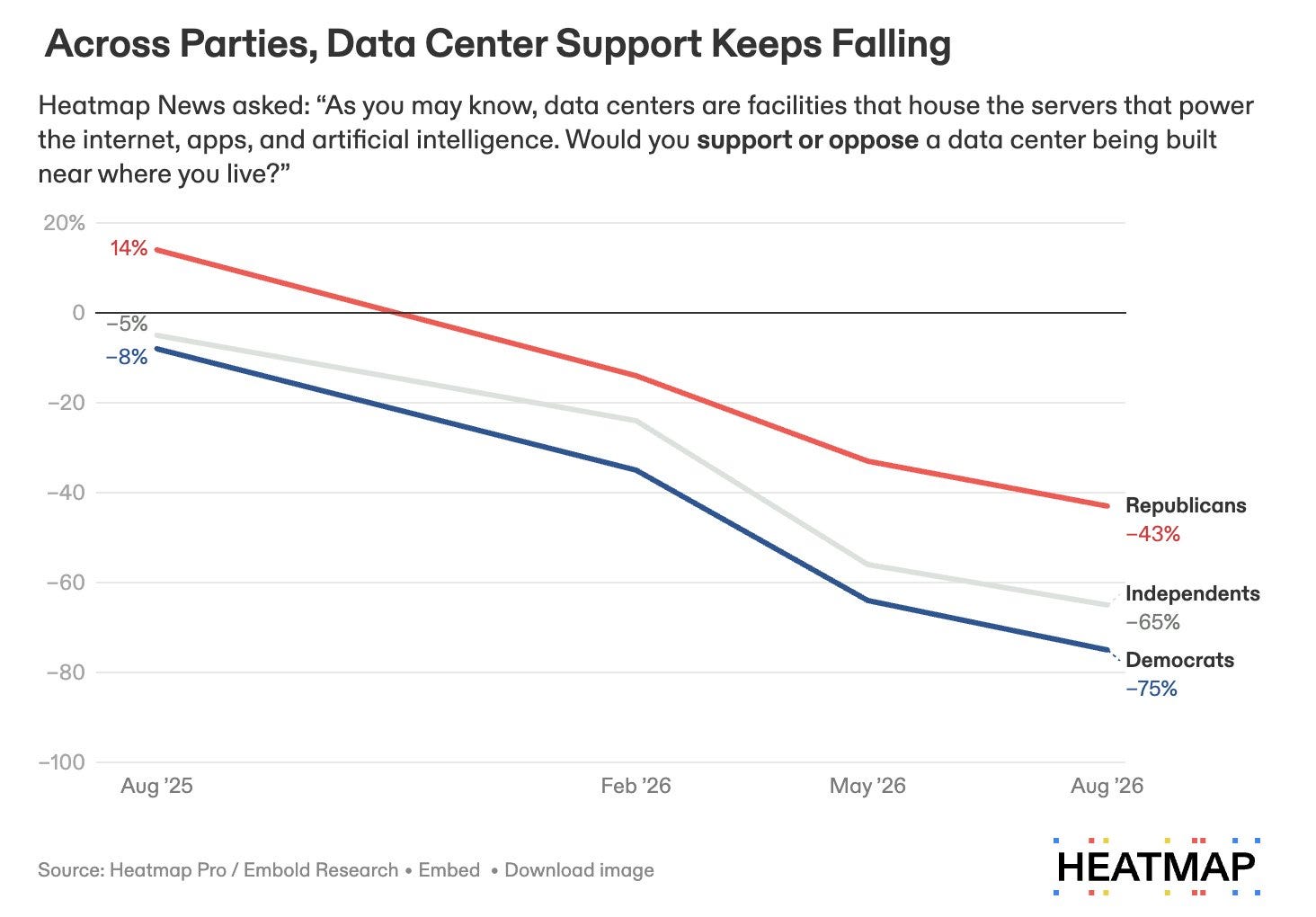
There have been dozens of other examples of state and local efforts to restrict construction and these efforts are not following a reliable partisan pattern. If there is any pattern at all, it is that the entire vibe over the last 12 months has become substantially more negative against new data centers. According to polling from HeatMap, the public support for data centers has collapsed across the ideological spectrum.
Why is this? If you listened to the rhetoric from the people who are leading the anti-data center charge, you might think that you know why they are anti-data-center. You would be wrong.
What They Say They Want
Cremieux wrote up a well researched overview of the reasons people give for hating data centers, why most of those reasons are false, and how learning the truth doesn’t seem to change people’s opinions. As for what to do about this, his conclusion was basically “do whatever it takes to placate the opposition and just build”.
I’m not sure that is going to work because I think the problems that opponents are citing aren’t really the thing that bothers them. Worries about water, energy, noise, aesthetics, and subsidies are not the root problem that people have with data centers.
The piece “No Data Centers In My Backyard” from Jasmine Sun cuts much closer to the heart of the issue. Sun writes from Wisconsin and Michigan about the tension between local leaders, who see that data centers are a natural fit for land that is otherwise undevelopable, and local residents, who fear that these big companies are making empty promises, manipulating local politicians, and planning to roll over the local community.
A core part of Sun’s reporting is that these residents have been made promises in the past by big corporations. She mentions a Foxconn deal in Wisconsin where the company was offered $4 billion in tax incentives for a plant that would have created 13,000 jobs. A decade later, only 1,000 jobs materialized.
The biggest difference between that deal and these data centers is that there are no promises for permanent jobs with data centers. After construction is compete, even a hyper-scale data center can be run with 100-200 employees, which is fewer employees than it takes to run a Bucee’s gas station. In 2025, a look at the permit filings across 17 data center projects showed plans only 1,547 permanent operations employees.
In the meantime, the tech companies who are building these data centers have fired 170,000 of their own employees in the last year alone, claiming that these layoffs are due to AI. For computer science students ready to start their careers in this high-tech culture, the on-ramp to a lucrative career has been blocked off. The unemployment rates for new graduates in computer engineering and computer science are higher than for graduates in art history.
While previous industrial construction projects promised thousands of jobs and economic revitalization, this time the industry that wants more data centers is plaining telling people that more data centers means fewer jobs.
Techies vs Normies
I consider myself a part of the tech industry. I am excited about AI and what we are going to build. This is a moment of tremendous opportunity. But I have also seen a very dark cloud rolling over our labor market. Most of my friends from Microsoft have been laid off or taken the “early retirement” buyout option. People in the industry that I’ve known for 15 years are writing LinkedIn posts about how excited they are for the future but they have an undertone of despair. It’s bad out there. It’s bad for 20 year tech veterans and for newly-minted junior developers.
While all this is happening, I see fountains of money gushing out of AI startups based in San Francisco and New York City. There is a hyper-optimism in my AI tech circles but the optimism is mostly about how good things are for us, the builders. To the extent that the tech culture believes things will get good for those outside our orbit (the normies), we seem to think that they will benefit from our grand benevolence and they will be lucky to get it. We seem to view people outside our tech sphere not as participants in the future but as recipients of whatever good things we create for them.
I don’t want to pick on Cremieux here but when you click to his post about trying to persuade the data center skeptics, the first thing you see is an AI company sponsor offering $300K for junior software engineers. All the positions are in-person in San Francisco. That is what things look like from inside the tech cultural bubble.
But when I look outside my tech bubble, I don’t see that energy or optimism. Much of tech culture is not open to everyone. It is an elitist culture that looks down on those who don’t share its values. One of the values they have is that you have to physically live in their bubble. You can make $300K as a junior engineer but not if you need to stay in Indiana so your spouse can be available to help your aging parents. You can raise millions for your AI startup but not if you live in the South or Midwest.
Venture capital is pouring billions into these companies. It isn’t because they have the best ideas or the best people. It is because they exist within the right culture, within the right cities. This isn’t a merit-based proposition. It’s a social club.
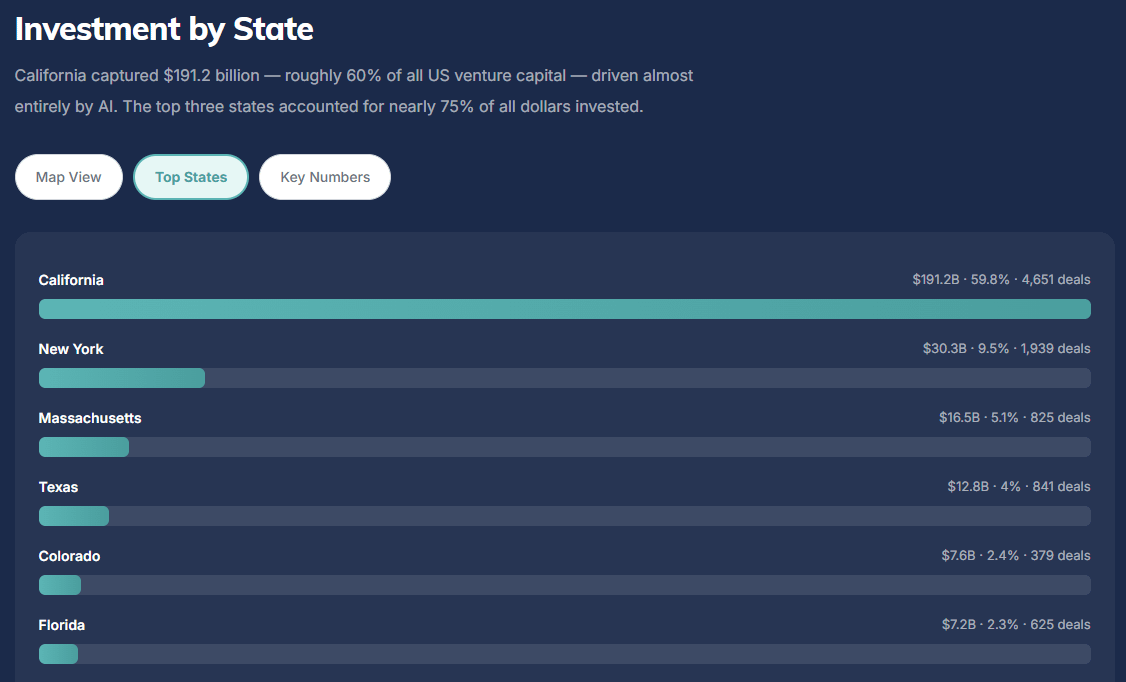
A tech company will spend $10 billion building a data center outside of a Wisconsin town but they won’t sponsor a little league team. They won’t support the local Girl Scouts. They won’t build a park. They want the land and space and they want to escape the burdensome regulations and insane anti-growth politics of California, but that doesn’t mean they actually like any of the people who live near their data centers. They don’t care if these outsiders find growth and success, they want them to get out of the way. And if paying enough taxes to reduce the overall tax burden of the local bumpkins is what placates them, fine. Whatever gets them to shut the hell up, leave us to our more important business, and accept their rightful place as the underlings of this particular arrangement. They don’t really have any place in our vision of the future.
This is starting to sound like a populist rant but that’s not where it is coming from. I love working in tech. I love the people in tech (most of them). I love what is happening in AI and I’m really excited to build with this new tool and to help others build. We are in the middle of the most exciting tech development of my lifetime (so far!) I want to share that excitement with friends and colleagues and especially with young people who are just graduating and coming into the world of tech. I love being a part of a culture that has this optimistic energy and eagerness to build the future. But I want this to be an open door. I want $300K junior developers in Atlanta and Nashville. If the AI promise is everything it says, then why are the jobs and money increasingly concentrated in a few culturally isolated tech hubs?
How Do We Fix This? Do We Even Know What We Are Trying To Fix?
Even assuming that I’ve identified this cultural backlash as the real reason that people are opposed to data centers, how would we fix this problem? I’m going to try to avoid the smarmy answer to this, which is “Go back in time and don’t make a decade worth of corporate and cultural mistakes that led to this problem”.
In my view, the core problem is the astonishing arrogance people within the tech culture. Even in debating this issue, the overwhelming response from libertarian and tech adjacent people seems to be dismissal and disdain. There is some outright anger against both people who oppose data centers and the politicians who are responding to this movement. There is a lot of this sentiment that “these idiots don’t know what is good for them” along with a seemingly resilient insistence that data center opposition is just successful Chinese psy-op. The “Chinese psy-op” position is a perfect distillation of this arrogance because it assumes that these people couldn’t possibly be thinking for themselves or using their own judgement, they must just be stupid people who are easily manipulated.
Of course, now I’m being a bit dismissive of my friends within tech culture. Many of them really do want to address the actual concerns that the data center opposition is raising. The problem is that very few of the data center opponents have articulated the cultural resentment I’ve brought forward here. It is reasonable for the pro-data-center people to become exasperated as they repeatedly ask:

And if we want to do a deep dive on introspection, we could argue that I’m being smug and arrogant in this very article towards the very people I say we need to understand because I’m elevating myself as the “normie-whisperer” while portraying myself as acting as “team tech” at the same time. Maybe I’m part of the problem that I’ve just identified.
At the end of the day, I genuinely do want the following things:
more data centers to support the most tremendous innovative technology of my lifetime
everyone to feel like they are participants in and beneficiaries of this emerging world
You shouldn’t have to live in San Francisco or New York City to feel like you’re a part of this revolution. I want the towns that build these data centers to feel like they are a part of this movement and not like they are a cheap and convenient place for Californians to build the things they need but are unable to build in their state because they have spent decades supporting a completely dysfunctional government that they inexplicably refuse to abandon. I want the tech companies to say “we want to build with you because we want you to be a part of this great thing” and not “we have to build with you because our native state is so screwed up that we can’t possibly build here despite having near-endless land and money”.
Flipping the script, there can’t be any form of compromise if the data center opposition can’t even tell us what changes they would accept in exchange for permission to build. If what they really want is to be treated with respect, they might not get that. Respect might simply not be on the table. If that’s the case, they will end up in a place where they don’t get the respect but they also don’t get the fringe benefits of boosted tax revenues.
From a practical perspective, I don’t see that the anti-data-center team needs to compromise. They have overwhelming support at the moment. If we want more data centers (and I do) the question then shifts to “how do we change this so that people will accept more data centers?” I suspect the answer is something close to “we need to treat these communities with respect and make them feel like a part of our team in this endeavor”.
What I see instead is the tech community doubling down on disdain. This makes me feel crazy because, as a tech person, I place very high value on strategies that work. If my first tactic doesn’t work with my target customer, I can bitterly blame the customer while my company goes out of business or I can change my tactics to something that finds more success.
To their credit, many in the tech community are trying to figure out what will work. To their detriment, most of these strategies assume that their opponents are stupid and that we can just deftly out-maneuver them with money and power and the fact that they are oh so much smarter than those flyover hicks. Which is exactly the attitude that makes negotiations pointless.
This is one of your best pieces, imho. You have captured so many issues while focused on data centers. I'm one of the anti-data center people because of the way they are being propagated. The arrogance isn't just from tech, though. It's coming from petty tyrants in local government who think they know best simply because they got the sales pitch from the guy in well-shined shoes (aka the lawyer). Every time I've posted against them, I get accused of supporting the CCP-and that lazy argument doesn't fly with me.
All of that to say-the bigger issue you're addressing is the frustration of natives in Tennessee, North Carolina, South Carolina, Virginia, Texas-pretty much anywhere in the Old South/Sun Belt. We've been inundated with new people, whether it's economic migrants from California and New York fleeing the policies they voted for, or it's H1B visa holders fleeing crowded zones for a new life. We've welcomed all of them with our usual Southern hospitality but in the past 20 years, the pace has been so rapid that many Southern areas are unrecognizable. We who have generations of history where we live are called names and steamrolled in favor of what someone from somewhere else declares.
The frustration is palpable. Not sure what the solution is at this point, either. The camps don't seem interested in common ground which is also the attitude I have found on data centers, flock cameras, and the like.
Why do the big companies get this wrong when it’s so obvious to small companies?
I think of a local business in my town. The owners live in a different *state* - but they have a presence at every town parade or social event. They sponsor Little League teams and highschool theater productions. They are a beloved part of the community even though they “only” do business here.
Maybe it’s because the tech companies view a community as simply a location, not a pool of potential customers and employees. They don’t care about goodwill because they don’t need to have an obvious connection to the *people* who live there.