

I’m a huge fan of Pangram. Pangram is a company that offers AI detection for text and images. There are a lot of tools for AI detection, but I haven’t seen any of them perform nearly as well as Pangram. I haven’t used it very much for image detection, but I’ve tested it on a lot of writing, both mine and others. It is wonderfully effective at delivering a reliable assessment of how much of a particular piece is AI-written.
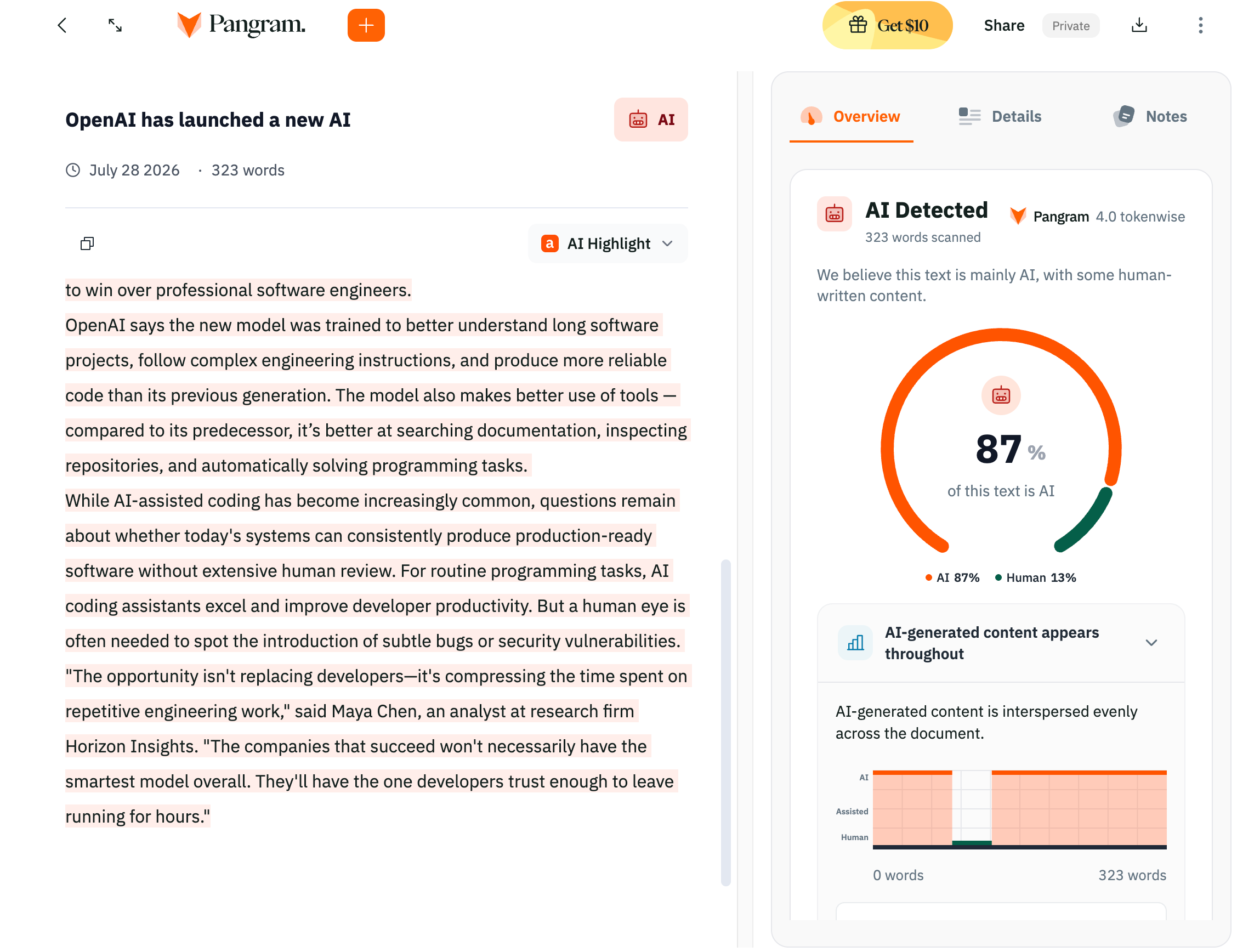
It’s remarkable to me that even the most pro-AI writers get very angry when their writing is exposed as being generated by an AI. Even while they say that the AI is smarter than 90% of people and that AI research and writing should be considered on par with human writing, they still show deep embarrassment when they are caught using AI to make their pro-AI arguments.
I take this as a positive sign that shame is still alive. Everyone who hasn’t been caught by Pangram seems to really like Pangram. It helps that Pangram CEO Max Spero (on substack as Max Spero) is really engaged with the discourse and is genuine in his desire to expose AI writing and protect human writing… even really bad human writing.
It is subsequently infuriating that there are people out there who are attempting to subvert the mission of AI writing detection. StealthGPT has no reason to exist except to erase the clear public good that Pangram provides.

To speak plainly, I hate StealthGPT. This is a product that was designed specifically for scam artists and duplicitous actors. The people using this tool don’t want to generate anything good in the world, they just want to get away with lying to their audience. This product is pro-pollution. Everyone involved in it should be ashamed to show their face in public.
Nobody Wants This
Unfortunately, there are a lot of effort going in to building AI products that are speeding us into a world that nobody wants. StealthGPT is an obvious example of this, but there is a glut of AI products whose goal seems to be fracturing reliable systems with no view of how to replace them.
Much of our vision of how to approach people is that unique requests are most likely the product of a person who cares about the details. A customer-focused business is going to change their patterns or services in order to accommodate a real human being who cares enough to ask for special services or particular treatment.
Most people (at least in an American cultural context) will accept the defaults and only make special requests when something matters deeply to them. The social cost of making a special request is quite high. It requires diligence, focus, and attention from the person making the request. We respond to this investment of attention with a return of attention. That is not only good business practice, it’s a polite and kind way to behave toward people.
But this entire pattern of customer service is built on a foundation that values human attention and time. A custom email or a phone call is a signal for that attention investment. When an AI bot can write that email or make that phone call, it feels like a betrayal of that silent social compact.
This pattern was recognized by a partner of an investment firm that sees a lot of these AI initiatives:

In reinforcement of this observation, Lauren Wilford related the following obervation:
I work at a restaurant that does events and we received some challenging last-minute requests from a client. We scrambled to fill them. I realized later that these requests were likely made by an AI agent, and that the human client might not have personally cared. This felt bad!
What felt bad about it was realizing that I was throwing myself at a problem to make a human client happy. But it’s possible it wasn’t even really a problem to the human. It’s highly possible the robot “prompted” needless work on my part in the name of “optimizing.”
I would be happy to do whatever if I knew a human thought about it and asked for it in good faith. It changes the calculus entirely if I realize that any given “ask” might be invented to make the agent looking like they are a tireless advocate and optimizer for their user. If a human client asks if we can do something unusual or off-menu for them, I’m going to assume they have a good reason, and they know it’s asking us to go above and beyond. This is different from an agent blueskying about what would be best for their user in some ideal world.
Now knowing that this is a possibility, it inherently makes me more on guard against special requests from clients, esp. delivered over email. I feel like I have to vet how serious they are and whether they really came from a person, and whether it’s a need or a “nice to have”.
This is just one example but I think this will happen all over in every sector. People will be flooded with agents “advocating for” or “negotiating for” their users, and social trust will degrade proportionately. People will play harder ball if everyone learns the trick.
One could argue that this is part of the growing pains of being at the front of a massive technological change and that we will adapt to this new technology-enabled communication paradigm as we have adapted to many before it. However, it is worth suggesting that we will lose something in this evolution. It may one day seem like a marvel that people were able to just pick up a phone and call a restaurant to make a request and your request would be heard, considered, and acted upon.
We will lose something if every business or customer service transaction becomes a fight between two robots. We will lose something even more profound if we restructure our world so that humans have to spend their very precious budget of time and attention debating with robots.
The Path Through
There is much to fear from a business environment that defaults to using AI to communicate with their customers or clients. I believe there are many clear use cases for AI as an intermediary, but I still have an instinctive revulsion to the pattern of using AI for these human-focused interactions. This is going to be a difficult pitch as AI attention becomes so cheap it is almost free while human attention becomes more and more expensive.
I believe that the companies that will thrive with this emerging technology will be the ones who recognize that there is a certain sanctity in every human-to-human interaction. This is why I wasn’t at all surprised to see that whoever is in charge of the customer experience at Chick-fil-a understands this distinction.


Chick-fil-a has spent decades building a powerful reputation as a customer-focused company and are considered top-tier when it comes to customer service. Their decision to reject AI for the customer-facing element of their business isn’t about money. It’s about maintaining the elevated human experience for their customers.
For the moment, the integrated use of AI might signal that a given business is on the front line of technological progress. In the coming years, the ubiquitous use of AI as a substitute for human interaction will be a signal that a company is cheap, careless, and holds their customers in some kind of disdain.
