

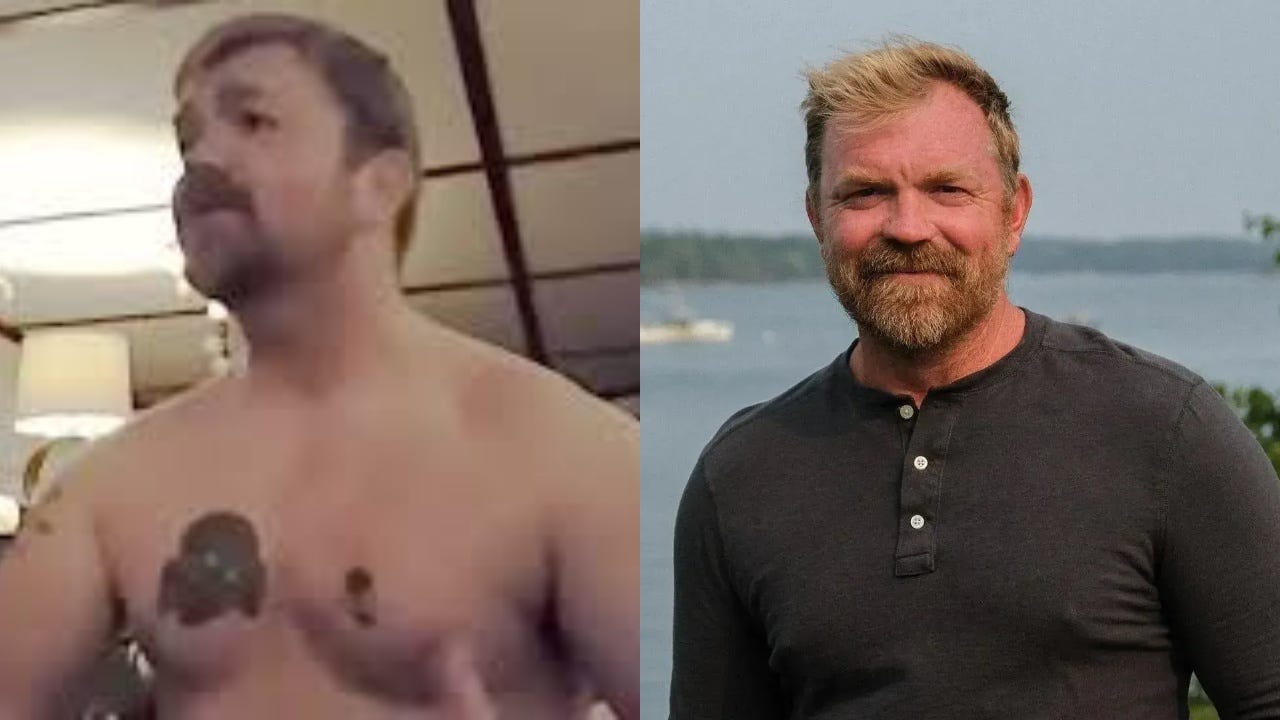
If you haven’t followed the endless misadventures of Graham Platner, I’ll try to catch you up in as few words as possible. Graham Platner is the Maine Democrat running for Senate against Susan Collins. His preference is that we refer to him as an oyster farmer and Marine Corps veteran because these sound good when you’re running for a Senate seat in Maine. The parts that get less promotion on the campaign website are his inflamatory history in which he said the Virgin Mary was a “skank”, called a Hamas attack on Israel “a damn fine looking and successful raid… I dig it”, told raped women to “take some responsibility”, and called various and sundry people racists, retards, and fags. No matter where you fall on the ideological spectrum, Graham Platner has plenty of ugly opinions and a seemingly endless well of disdain for you.
Oh, I almost forgot, he got a Nazi tattoo on his chest.
This issue of Marginally Compelling is free to all. This is made possible by the generous sponsorship of “I wrote a book, it’s great, go check it out”.
All this is extremely funny and I highly recommend you follow this train-wreck of a campaign all the way until he gets elected into the Senate over the most moderate Senate Republican of the last 20 years because the party fundamentals are atrocious.
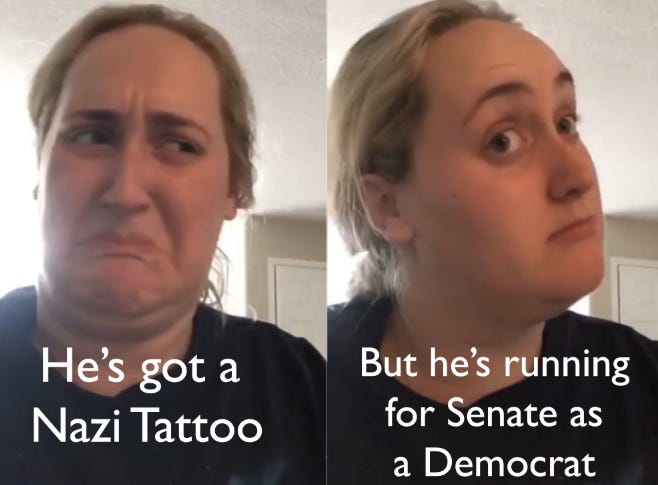
But we’re not here to talk about Platner’s history or campaign. I want to focus on the how Democratic opinion-makers are responding to Platner. The clear proof of these revelations have driven them to do some real soul searching by asking the question so many of us have had to grapple with every day: “Does getting this Nazi tattoo make me a Nazi?”
There are many things that can make you a Nazi. Those things include
throwing up your hand at a campaign event (like Corey Booker)
These are all pretty egregious signs of being a Nazi, but is it really fair to add “getting a Nazi tattoo” to this list?
As it turns out, the very smartest among the Democrat pundit class are here to let us know that the answer is “No, a Nazi tattoo isn’t really very meaningful as long as you are, at your heart of hearts, a good person.” How can we tell you’re a good person? The easiest way is to run for Senate as a Democrat.
Matthew Yglesias said that “the tattoo situation reflects somewhat poorly on him in a non-specific way” but that Platner “gets a pass on being a Nazi because progressives think he’s progressive (ie not a Nazi)”.
Jon Favreau (Obama speechwriter and host of Pod Save America) attacked critics of Platner, claiming that they were being intellectually dishonest and sneered at their criticisms of this tiny little oopsie in judgement made by a goofy guy in his 20’s.
The brazen defense of this clearly disqualifying feature has been the subject of no small mockery. But I’ve had my fun here, so let’s set the mocking tone aside for a moment and get to the foundation of what is going on in this sudden disregard for the importance of symbols and the promotion of the SS-Totenkopf.
The basis of rational debate and the reason we value objective judgement calls is because it starts with gathering evidence of the reality before us and allowing the facts and the circumstances to tip the scales in our minds. The hope is that, by moving from what is (the facts) to what ought to be (the ideal) we can come to an agreement that one action is laudable, another action is permissible, a third action is excusable, and some actions are unforgivable.
All actions are subject to a context and happen within a time and place but we have to draw the lines somewhere. It is considered good moral and rational practice to hold your own team to the same standards of behavior (or maybe even higher standards) that you would demand from the other team.
“Nazi tattoo” is so far over the line that no one on the left would even begin to tolerate such a vice from a Republican Senate candidate or from a right-leaning moderate or from some random kid who was trying to get into an Ivy League school. That is the kind of action that effectively results in social exile or, at the very least, a hard stop to a career in elected public service.
And yet we have the king-makers of the Democratic party digging in their heels that the Nazi tattoo is a nothingburger. It is particularly funny to watch Yglesias tie himself into these intellectual knots and rhetorically sneer at anyone who might suggest that a Nazi tattoo is a disqualifying feature for a Senate candidate. If he had any self-respect, Yglesias would simply say “you know what, that guy is a lost cause. I just can’t diminish myself to the point of saying that a Nazi tattoo is no big deal.”
To complain about the self-abasement of these opinion-makers and pundits is to misunderstand what has happened to partisan discourse over the last decade. There is no forward reasoning anymore. They do not start from the facts at hand and drive earnestly and in open debate toward a moral conclusion.
What we see here is Jon Favreau, Matthew Yglesias, and most Democrats perform a reasoning chain that starts at the end. In the end, they need Platner to win this race. In order for him to win this race, he must be seen as a good guy, a progressive guy, a better person than his opponent. The conclusion is the starting point and they will employ any reasoning chain that gets them from “he has a Nazi tattoo” to “he’s a good guy”.
Do they believe what they are saying? That’s the wrong question. They don’t believe anything that they say. Belief does not drive their rhetorical strategies. They need an outcome (Senator Graham Platner) and so they are saying words that they think will increase the probability of that outcome. Any words will do, but the strategy that makes the most sense to them is to say that symbols do not matter, the past is meaningless, and that we already know he’s a good guy (because, duh, he’s a Democrat) and that’s really all anyone cares about.
They aren’t lying to themselves because they don’t believe there are such things as truth and lies. There are only strategies to deliver the desired results.
Sure, we can make fun of them. We should make fun of them not just because they are outing themselves as ridiculous people but because it is funny and laughter is good for the soul.
The thing we should hold close is that the reason they have fallen into this particular trap of intellectually beclowning themselves is because this backward logical curveball is how they intellectually approach most things. Most of their reasoning starts at the desired outcome and works backwards, omitting facts they don’t like, leaning into implausible rationales, intellectualizing what they think will be effective, and dismissing plain facts that aren’t helpful.
You could say “they have always done this” and perhaps that is so. But we should hope that there would be a situation so outlandish, so egregious, so ridiculous that they are forced to take a step back and say “well, I can’t go all in on this one. It’s just a step too far.”
This week we learned that, wherever a “step too far” is, it’s somewhere past defending a Nazi tattoo.
"It is considered good moral and rational practice to hold your own team to the same standards of behavior (or maybe even higher standards) that you would demand from the other team."
I really, really wish this was true. Our politics would be so much healthier if people believed this. But they don't, and haven't for at least the last decade. Partisans will hold their own team accountable only when forced to do so, and only when it's obvious that it's a lost cause. If there's a chance that their candidate can still win, they'll overlook anything short of murder. (And maybe even that.)
Yes, we know that MattY has been on the record that outright lying is just fine for The Cause(TM).
My question is: do they think anybody really believes them, who didn't already fall in with the "Democrat = Good" equation.
One wonders who they are performing this bullshit for.
I also wonder why Maine Democrats didn't have anybody better to run.
I'm a NY Republican, so I understand how we ended up with George Santos. We were trying to get candidates for every race in NY, and Repubs are a bit thin on the ground in NY in certain areas. We don't have great vetting. But that was just a House seat. Not the Senate. Usually, we get relatively boring-ish people to run for that.
I am unfamiliar with Maine politics, but this is the best they could do for a Senate seat? Really?